Blood Biomarker Predicts Dementia Risk in Women Up to 25 Years Before Symptoms — InnoDexis Analysis
Longitudinal research tracking 2,766 women over a 25-year period identifies plasma p-tau217 as a powerful early indicator of future cognitive decline and dementia risk.
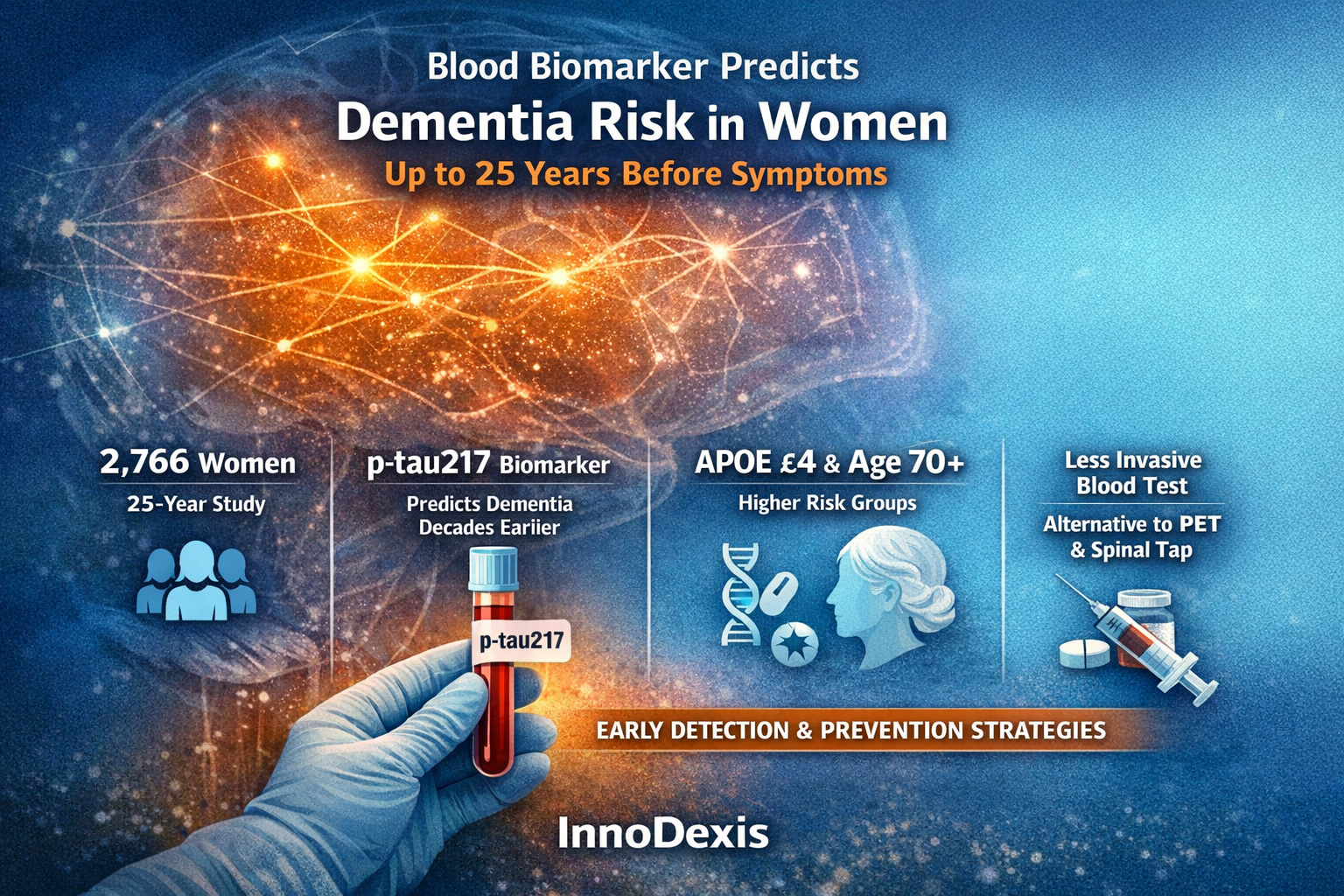
InnoDexis has published its latest Innovation Intelligence Report covering blood-based biomarkers for dementia prediction, analyzing a major longitudinal cohort study conducted in the United States. The report examines research based on baseline blood samples from 2,766 cognitively unimpaired women enrolled in the Women’s Health Initiative Memory Study, with up to 25 years of follow-up. The analysis reveals that plasma phosphorylated tau 217 (p-tau217) can predict a woman’s risk of developing dementia as many as 25 years before clinical symptoms emerge. The findings suggest that blood-based biomarker testing could significantly expand early detection capabilities and enable earlier preventive strategies for neurodegenerative disease.
Key Findings
The study identifies plasma p-tau217 as a strong predictive biomarker for dementia risk decades before symptom onset. Elevated levels of p-tau217 in baseline blood samples were strongly associated with later development of mild cognitive impairment and dementia during the follow-up period. This predictive capability extends up to 25 years before symptoms appear, representing one of the longest lead times demonstrated for dementia risk prediction using a blood-based test.
The analysis draws on a longitudinal cohort of 2,766 cognitively healthy women, making it one of the largest long-term datasets examining biomarker-based prediction of neurodegenerative disease in asymptomatic individuals. By correlating early blood biomarkers with later clinical outcomes over multiple decades, the research demonstrates how molecular signals present years earlier may indicate future neurological decline.
Results also indicate that risk prediction varies across population subgroups. Higher p-tau217 levels were more strongly associated with poorer cognitive outcomes among women over age 70 and among those carrying the APOE ε4 genetic risk factor, which is widely recognized as a genetic predisposition linked to Alzheimer’s disease.
Hormone therapy was also identified as a potentially relevant factor. The biomarker appeared more predictive of dementia among women randomized to estrogen plus progestin therapy, suggesting that biological interactions between hormone exposure and tau-related pathology may influence dementia risk trajectories.
A significant advantage highlighted in the report is the accessibility of blood-based testing compared with existing diagnostic methods. Current approaches to detecting Alzheimer’s-related pathology often rely on PET imaging or cerebrospinal fluid analysis, which require specialized equipment or invasive procedures. A plasma biomarker test offers a less invasive and potentially more scalable alternative for identifying individuals at elevated risk.
Strategic Insight and Trend Analysis
Taken together, the findings reflect a broader shift in neurodegenerative disease research from symptom-based diagnosis to molecular-level risk prediction decades in advance. The identification of plasma p-tau217 as a long-term predictor suggests that dementia may be detectable at a biological level far earlier than previously possible using conventional clinical assessment.
This trend aligns with the increasing focus on preventive neurology, where identifying high-risk individuals years before cognitive symptoms appear could enable earlier monitoring, targeted intervention strategies, and more effective clinical trial design. For researchers and clinicians, biomarkers such as p-tau217 may help stratify populations according to risk, improving the ability to study how genetics, aging, and environmental factors influence disease progression.
The research also demonstrates the strategic importance of large longitudinal datasets in innovation within medical diagnostics. By analyzing baseline biomarker data against decades of follow-up outcomes, scientists can uncover predictive relationships that shorter clinical studies cannot detect. This approach is becoming central to understanding chronic and age-related diseases.
However, the report also highlights an important limitation: the clinical utility of such predictive testing remains under investigation. While the biomarker shows strong predictive associations with dementia risk, further studies are required to determine how testing could be incorporated into routine medical care and whether early identification will meaningfully alter patient outcomes.
In innovation intelligence terms, the emergence of blood-based predictive biomarkers represents a convergence of biotechnology, diagnostics, and longevity science, indicating a growing research focus on detecting neurodegenerative risk at the earliest possible biological stage.
Global and Industry Implications
For corporates and healthcare R&D teams, the findings highlight expanding opportunities in diagnostic biomarker development and precision monitoring tools for neurodegenerative disease. Blood-based biomarkers such as p-tau217 could enable scalable screening strategies and support pharmaceutical development by identifying patients earlier in disease progression.
For investors and capital allocators, the research signals increasing momentum in the biomarker diagnostics segment of the biotechnology sector. Technologies capable of predicting neurological diseases decades in advance could become foundational tools for drug development, population screening, and clinical trial recruitment.
For policymakers and national health systems, the possibility of identifying individuals at elevated dementia risk long before symptoms arise raises strategic questions about population-level prevention strategies, long-term care planning, and early monitoring frameworks. Accessible blood-based diagnostics could potentially reshape how health systems approach aging-related cognitive disorders.
InnoDexis Statement
“Predictive biomarkers capable of identifying neurodegenerative risk decades before symptoms emerge represent a structural shift in how dementia may be studied, monitored, and potentially prevented,” noted InnoDexis in its latest intelligence report.
Conclusion
The identification of plasma p-tau217 as a long-term predictor of dementia risk illustrates how biomarker-based diagnostics are expanding the time horizon for detecting neurodegenerative disease. As research continues to explore interactions between genetic risk factors, aging, and biological markers, early detection capabilities are likely to become a central focus of dementia research and healthcare innovation. For stakeholders across biotechnology, healthcare systems, and policy institutions, monitoring advances in blood-based biomarkers will be critical in understanding the future direction of neurodegenerative disease prevention and management.
The complete Blood-Based Biomarkers for Long-Term Dementia Risk Prediction report is available to InnoDexis subscribers and enterprise clients.
About InnoDexis
InnoDexis is a global Innovation Intelligence platform that tracks, analyzes, and interprets breakthrough innovations, prototypes, and emerging technologies across industries and countries. Its intelligence helps corporates, investors, and policymakers understand the true structure and direction of global innovation. Learn more at innodexis.ai.