BCI and Neurotech Cross a Commercial Threshold as First-in-Human Wireless Implants, FDA Milestones, and Consumer Wearables Advance Simultaneously Across 67 Tracked Innovations
A dual-stream analysis of 67 validated innovations across 12 countries finds that the brain-computer interface sector is bifurcating into high-acuity implantable systems and accessible consumer neurotechnology, with AI-enhanced neural signal processing emerging as the connective platform layer across both markets.
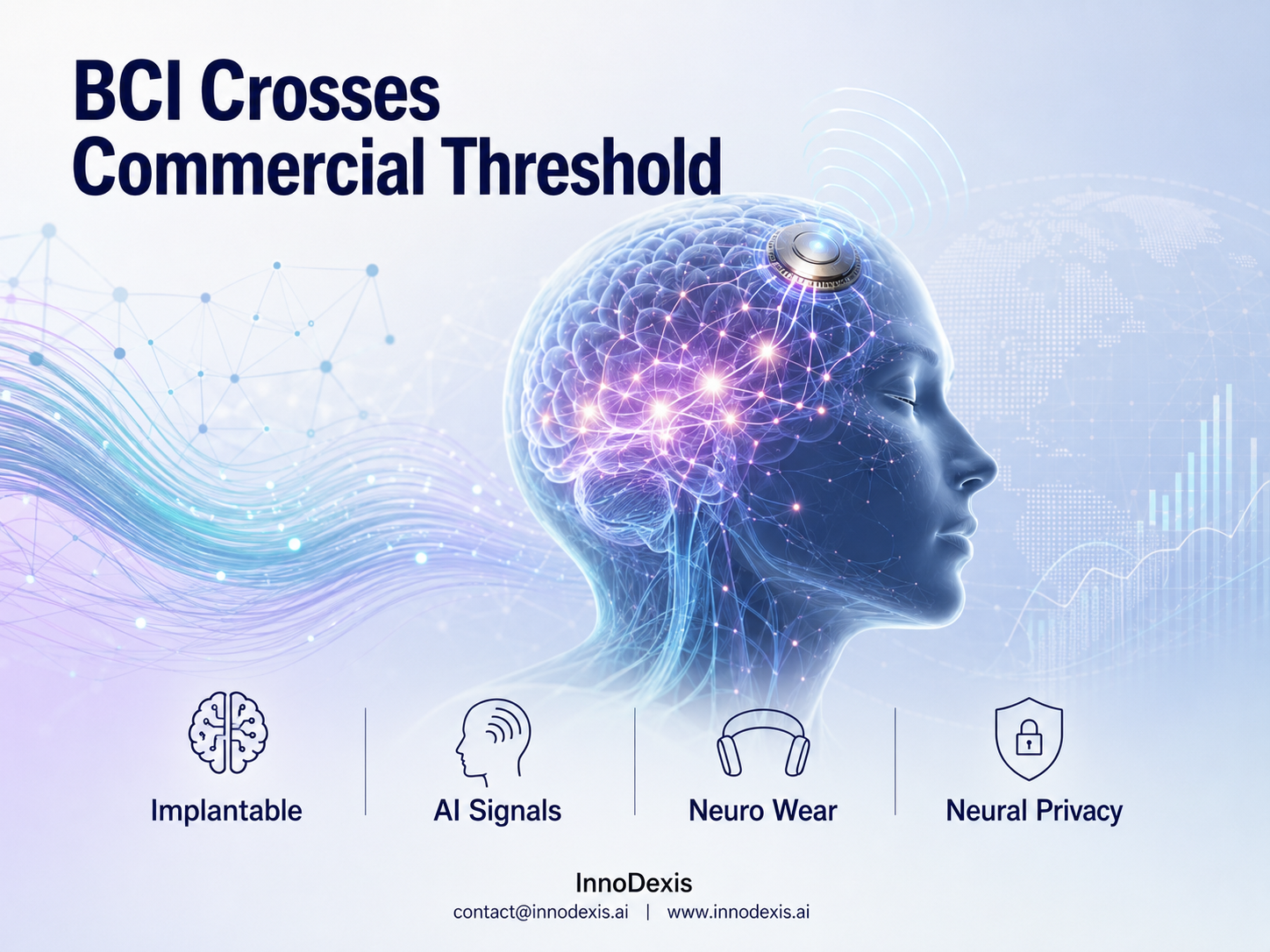
InnoDexis has published its latest Innovation Intelligence Report covering the global brain-computer interface and neurotechnology commercial ecosystem, analyzing 67 validated innovations across Institute and Corporate streams spanning 12 countries as of June 2026. The report reveals that BCI and neurotech have crossed a critical commercial threshold - with the University of Michigan completing the first-in-human wireless BCI implant, the BrainGate consortium achieving FDA Investigational Device Exemption in a record four-year timeline, and consumer-grade neurotechnology products reaching market deployment simultaneously. The mean InnoDexis Score for the corporate stream stands at 7.1 out of 10, above the full-corpus benchmark of 5.6.
Key Findings
The United States dominates the research landscape with 33 of 48 Institute-stream innovations, anchored by MIT, Northwestern, Rice, Yale, Caltech, Columbia, and Mayo Clinic. Germany is the second-most active research country with five innovations, led by Heidelberg University Medical Center, the Technical University of Munich, and Fraunhofer Institute. The remaining ten Institute-stream innovations are distributed across Switzerland, Sweden, Belgium, China, Denmark, Spain, Japan, Hong Kong, New Zealand, and the United Kingdom, indicating a growing international research base against clear US dominance.
Nine of 18 scored corporate records are classified as High Disruption Potential - the highest concentration recorded in any InnoDexis sector report to date - and nine of 18 are rated High Investment Attractiveness. Four companies are classified at the highest disruption tier, Paradigm Shift: ONWARD Medical, whose ARC Therapy represents the first commercially deployed BCI-enabled spinal cord stimulation system; BrainGate and Rice University, for achieving FDA IDE in four years; ABILITY Neurotech, for receiving IMDD approval to initiate a chronic implantable BCI clinical trial; and GlassView, whose finding that 95% of neural signals fail to predict consumer behaviour invalidates current neuromarketing industry assumptions.
Two landmark clinical milestones define the implantable BCI frontier in 2026. The University of Michigan implanted the first-in-human Paradromics wireless brain-computer interface, removing the tethering constraints that limited earlier systems. Yale University's T-PHATE algorithm enables BCI users to achieve neural control in under one hour by working with natural brain plasticity rather than against it - directly addressing the training burden that has historically constrained both clinical scalability and consumer-grade BCI adoption.
The corporate stream spans three structurally distinct competitive tiers operating simultaneously. Clinical implantable BCI leaders include ONWARD Medical at TRL 9 with strong Q1 2026 commercial results, ABILITY Neurotech at TRL 6 with IMDD approval, and BrainGate at TRL 7 with active clinical trial enrolment. Non-invasive neuromodulation players include GrayMatters Health, which launched Prism Imagine - an fMRI-informed biomarker platform targeting 16 million treatment-resistant depression patients in the United States - and Vielight, which published results from seven peer-reviewed studies validating its photobiomodulation platform across Alzheimer's and Parkinson's indications. Consumer neurotech challengers include Sychedelic, which closed a USD 3.5 million seed round for the first closed-loop neurostimulation headphones, and MindGalaxy, which unveiled UnaBand - the first FemTech BCI wearable tracked in the InnoDexis corpus.
Five research gaps identified in the Institute stream represent forward-looking commercial intelligence. No corporate-stream entity has yet achieved commercial deployment of a fully wireless implantable communication BCI - the primary competitive opportunity for ABILITY Neurotech and future entrants. All current commercial BCI systems address motor function alone, with sensory feedback integration representing the missing element across ONWARD Medical, ABILITY Neurotech, and BrainGate. UCSF's demonstration of real-world Parkinson's movement decoding in a fully implanted device reveals a gap between lab-validated and real-world-validated adaptive neurostimulation estimated at a USD 2–4 billion commercial opportunity within existing neuromodulation markets.
The global bioelectronic medicine market is projected to reach USD 35.81 billion by 2030, up from USD 24.21 billion in 2025 - a 48% expansion over five years. Within this, neuromodulation devices represent the largest clinical sub-segment at an estimated USD 18.5 billion by 2030, with pure BCI systems at USD 6.4 billion, consumer neurotechnology at USD 4.2 billion, and neuroprosthetics at USD 3.1 billion. Structural demand is underpinned by over one billion people affected by neurological conditions globally, a growing mental health crisis driving non-pharmacological intervention adoption, and AI integration unlocking product categories that were technically infeasible three years ago.
Strategic Insight and Trend Analysis
The most consequential structural finding of the BCI and neurotech 2026 dataset is the simultaneous - rather than sequential - advancement of clinical-grade implantable systems and consumer-grade wearable products. In most deep-tech sectors, clinical validation precedes consumer deployment by a decade or more. In BCI, the two markets are advancing in parallel, fed by a common AI infrastructure layer and converging on overlapping enabling technologies - particularly in wireless neural signal transmission, closed-loop adaptive stimulation, and miniaturised bioelectronics.
The compression of the research-to-clinical timeline is the sector's most significant structural development. BrainGate's four-year FDA IDE achievement - against an industry norm of eight to twelve years for implantable neural devices - signals that the regulatory infrastructure for BCI is maturing alongside the technology itself. This compression directly reduces capital requirement and timeline risk for the next generation of implantable BCI companies, creating a structural shift in the risk profile of the sector.
AI has become the enabling platform that connects all six technology clusters identified in the report. Yale's T-PHATE algorithm, Columbia's brain-controlled hearing system, GrayMatters Health's fMRI biomarker platform, and GlassView's neural signal intelligence work all depend on AI for neural signal interpretation. Critically, GlassView's finding - that current neural AI fails to predict consumer behaviour 95% of the time - does not weaken the AI thesis but reinforces it, by identifying the gap that next-generation neural AI systems must close and thereby defining the commercial opportunity for whoever closes it first.
The neural privacy question is the sector's defining ESG challenge. As BCI systems become capable of decoding intentions and emotional states, data governance frameworks will become a primary differentiator for institutional investors and regulators in markets where EU AI Act provisions and emerging US neurorights legislation are beginning to formalise requirements.
Global and Industry Implications
For corporates and R&D teams, the five research gaps identified in the Institute stream provide a structured map of where the next commercial breakthrough is most likely to originate. Sensory feedback integration, real-world adaptive neurostimulation, and enteric nervous system neuroprosthetics represent gaps with no current commercial entrants and substantial addressable markets. ClearPoint Neuro's 10-year focused ultrasound partnership with Sungkyunkwan University establishes a replicable model for long-duration structured R&D collaboration that connects listed commercial platforms to academic research programs without the execution risk of early-stage acquisition.
For investors and capital allocators, the 47% High Investment Attractiveness rate across the corporate corpus - more than double the expected cross-sector rate - identifies BCI as a structurally elevated investment environment. The five companies on the InnoDexis BCI Watch List - ABILITY Neurotech, Sychedelic, GrayMatters Health, ClearPoint Neuro, and GlassView - each carry near-term milestones in clinical enrolment, product launch execution, payor coverage decisions, and neural AI commercialisation that will determine their next capital raise within twelve months. The absence of major pharma strategic investments in the current corpus is identified as a timing gap likely to close in H2 2026, with ClearPoint Neuro, Vielight, and GrayMatters Health flagged as the most probable partnership targets.
For policymakers and national innovation bodies, the US concentration of 69% of Institute-stream BCI innovations reflects the combined effect of NIH funding scale, DARPA BCI programmes, and the regulatory infrastructure of the FDA Breakthrough Device Designation pathway. The four-year IDE timeline achieved by BrainGate demonstrates that this regulatory architecture is functioning as intended for implantable neural devices. National innovation bodies in Europe and Asia-Pacific seeking to develop competitive BCI research ecosystems will find the most direct leverage in replicating the academic-to-clinical partnership model - anchored by hospital networks, structured IP arrangements, and direct regulatory engagement - that characterises the US BCI leaders.
InnoDexis Statement
"The BCI sector in 2026 is experiencing a convergence that most sectors never see - simultaneous clinical milestone accumulation and consumer product deployment, unified by an AI platform layer that is still in its early innings of capability," noted InnoDexis in its latest intelligence report.
Conclusion
The BCI and Neurotech Commercial Ecosystem 2026 report establishes that the sector has crossed from a research-dominant to a commercially active landscape, with implantable systems, non-invasive neuromodulation platforms, and consumer wearables advancing across all three tiers simultaneously. Across 67 validated innovations from 12 countries, the evidence confirms a sector defined by accelerating regulatory timelines, bifurcating market structures, and AI as the connective platform layer. As clinical trial enrolment milestones accumulate, consumer product credibility thresholds are crossed, and pharma-neurotech partnerships emerge, the organisations with systematic early intelligence on each of these transitions will hold the most durable strategic and commercial advantage. The complete BCI and Neurotech Commercial Ecosystem 2026 Report is available to InnoDexis subscribers and enterprise clients.
About InnoDexis
InnoDexis is a global Innovation Intelligence platform that tracks, analyzes, and interprets breakthrough innovations, prototypes, and emerging technologies across industries and countries. Its intelligence helps corporates, investors, and policymakers understand the true structure and direction of global innovation. Learn more at innodexis.ai.