Antarctic Research Expands Into Climate Intelligence Infrastructure as Sea Ice and Ecosystem Monitoring Intensify
A 183-day Antarctic mission led by the Alfred Wegener Institute signals a broader transition from isolated polar expeditions toward integrated environmental intelligence systems designed to monitor accelerating climate instability.
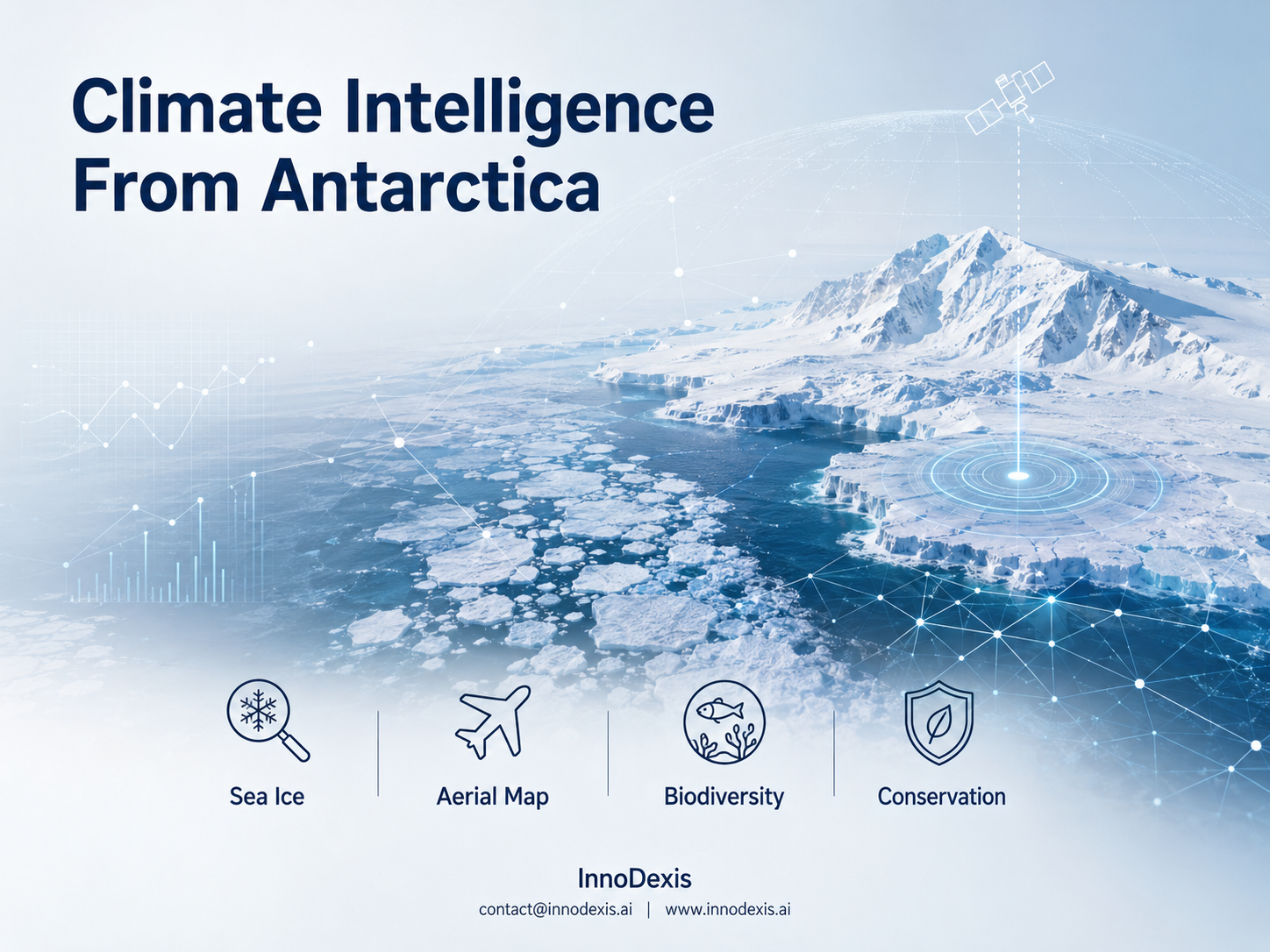
InnoDexis has published its latest Innovation Intelligence Report covering Antarctic climate research and polar environmental monitoring systems, analyzing emerging developments in sea ice dynamics, biodiversity assessment, and climate intelligence infrastructure. The report reveals that researchers from the Alfred Wegener Institute completed a 183-day expedition aboard the Polarstern in the Weddell Sea, combining sea ice analysis, aerial surveys, sediment investigations, and biodiversity research to examine how climate change is reshaping Antarctic systems. The findings indicate that polar missions are increasingly functioning as continuous environmental sensing platforms with implications for climate forecasting, conservation planning, and global risk assessment.
Key Findings
The report identifies the scale of direct sea ice analysis as one of the mission’s most significant operational achievements. Researchers conducted 35 days of direct sea ice measurements during the expedition, generating detailed observational data on ice conditions and structural variability within the eastern Weddell Sea. The work contributes to growing scientific concern surrounding accelerating Antarctic sea ice decline and its implications for global climate systems.
Another major finding involved aerial thickness mapping conducted across more than 4,400 kilometers. These large-scale airborne surveys enabled researchers to examine sea ice distribution and thickness patterns at regional scale, strengthening the precision of climate monitoring capabilities. The integration of aerial sensing with direct field measurements reflects the increasing technological sophistication of modern polar research operations.
The expedition also focused extensively on biodiversity and ecosystem function analysis. Scientists investigated biological activity and ecological interactions across the eastern Weddell Sea to better understand how changing environmental conditions are influencing marine ecosystems. The findings contribute to broader efforts aimed at understanding biodiversity resilience under conditions of climate stress and ecological disruption.
A further notable outcome was the identification of a previously unmapped island during the mission. Although secondary to the expedition’s climate objectives, the discovery highlights how changing ice conditions and advanced observational methods continue to alter scientific understanding of Antarctic geography and environmental accessibility.
The report additionally highlights the expedition’s contribution to marine conservation initiatives. Findings from the mission are expected to support ongoing discussions surrounding the establishment of a protected marine area within the region. This reflects the growing convergence between climate science, biodiversity protection, and international environmental governance frameworks.
Collectively, the mission demonstrates how Antarctic expeditions are evolving into integrated intelligence systems capable of simultaneously monitoring atmospheric conditions, ocean dynamics, ecosystem change, and cryosphere instability.
Strategic Insight and Trend Analysis
The broader trend emerging from the report is the transformation of polar research into long-duration climate intelligence infrastructure. Historically, Antarctic missions were often structured around isolated scientific objectives or exploratory research programs. The Polarstern expedition demonstrates a different operational model in which multiple environmental systems are analyzed simultaneously through interconnected sensing, mapping, and observational capabilities.
This shift is becoming increasingly important as polar regions emerge as critical indicators of planetary instability. Antarctic sea ice decline is no longer viewed solely as a regional environmental issue. Instead, it is increasingly linked to larger questions involving ocean circulation patterns, global temperature regulation, biodiversity disruption, and long-term climate predictability. As a result, polar research infrastructure is beginning to resemble strategic monitoring infrastructure designed to support continuous global environmental intelligence generation.
The integration of sea ice measurements, aerial surveying, sediment analysis, and biodiversity research within a single expedition also reflects a growing systems-level approach to climate science. Rather than studying environmental variables independently, scientific institutions are increasingly examining how atmospheric, oceanic, geological, and biological systems interact under climate pressure. This integrated analytical framework may become increasingly central to future climate forecasting methodologies.
The mission additionally illustrates the expanding role of advanced sensing technologies in environmental science. Large-scale aerial mapping and long-duration observational operations are enabling researchers to collect higher-resolution environmental data across geographically extreme regions. As climate variability accelerates, demand for persistent monitoring capabilities may continue increasing across polar and oceanographic research systems.
The report suggests that Antarctic research infrastructure may gradually evolve into a globally significant strategic asset supporting climate forecasting, ecological monitoring, conservation planning, and international environmental coordination.
Global and Industry Implications
For corporates and R&D teams, the findings reinforce the growing importance of climate intelligence, environmental sensing technologies, and predictive modeling infrastructure. Organizations operating in energy, shipping, insurance, agriculture, and environmental analytics may increasingly depend on high-resolution climate data originating from polar monitoring systems.
For investors and capital allocators, the report signals expanding strategic relevance for climate infrastructure, oceanographic technologies, remote sensing systems, and environmental data platforms. Long-duration environmental intelligence capabilities may become increasingly important as climate-related risk modeling and sustainability-linked investment strategies mature.
For policymakers and national innovation bodies, the findings highlight the need for sustained investment in polar science, climate observation systems, and international environmental coordination frameworks. Antarctic instability may increasingly influence global climate resilience planning, marine governance discussions, and biodiversity protection strategies across multiple regions.
InnoDexis Statement
“Polar research missions are increasingly evolving into integrated climate intelligence systems capable of generating strategic environmental insights across interconnected global ecosystems,” noted InnoDexis in its latest intelligence report.
Conclusion
The Polarstern expedition reflects a broader transformation underway across climate science and environmental monitoring. As Antarctic systems experience increasing instability, scientific missions are expanding beyond exploration into continuous intelligence generation platforms capable of supporting global climate forecasting and ecological assessment. The convergence of oceanography, biodiversity science, atmospheric analysis, and remote sensing may significantly reshape how environmental risks are monitored in coming decades. InnoDexis will continue tracking developments in polar research infrastructure, climate intelligence systems, and advanced environmental monitoring technologies shaping the future of global sustainability analysis. The complete Antarctic Climate Intelligence Infrastructure Report is available to InnoDexis subscribers and enterprise clients.
About InnoDexis
InnoDexis is a global Innovation Intelligence platform that tracks, analyzes, and interprets breakthrough innovations, prototypes, and emerging technologies across industries and countries. Its intelligence helps corporates, investors, and policymakers understand the true structure and direction of global innovation. Learn more at innodexis.ai.