Ancient Subglacial Methane Release Detected Beneath Greenland Ice Sheet as Warming Intensifies
Research from University of Oulu identifies biologically produced methane escaping from beneath Greenland’s ice sheet, indicating a potentially active climate feedback mechanism.
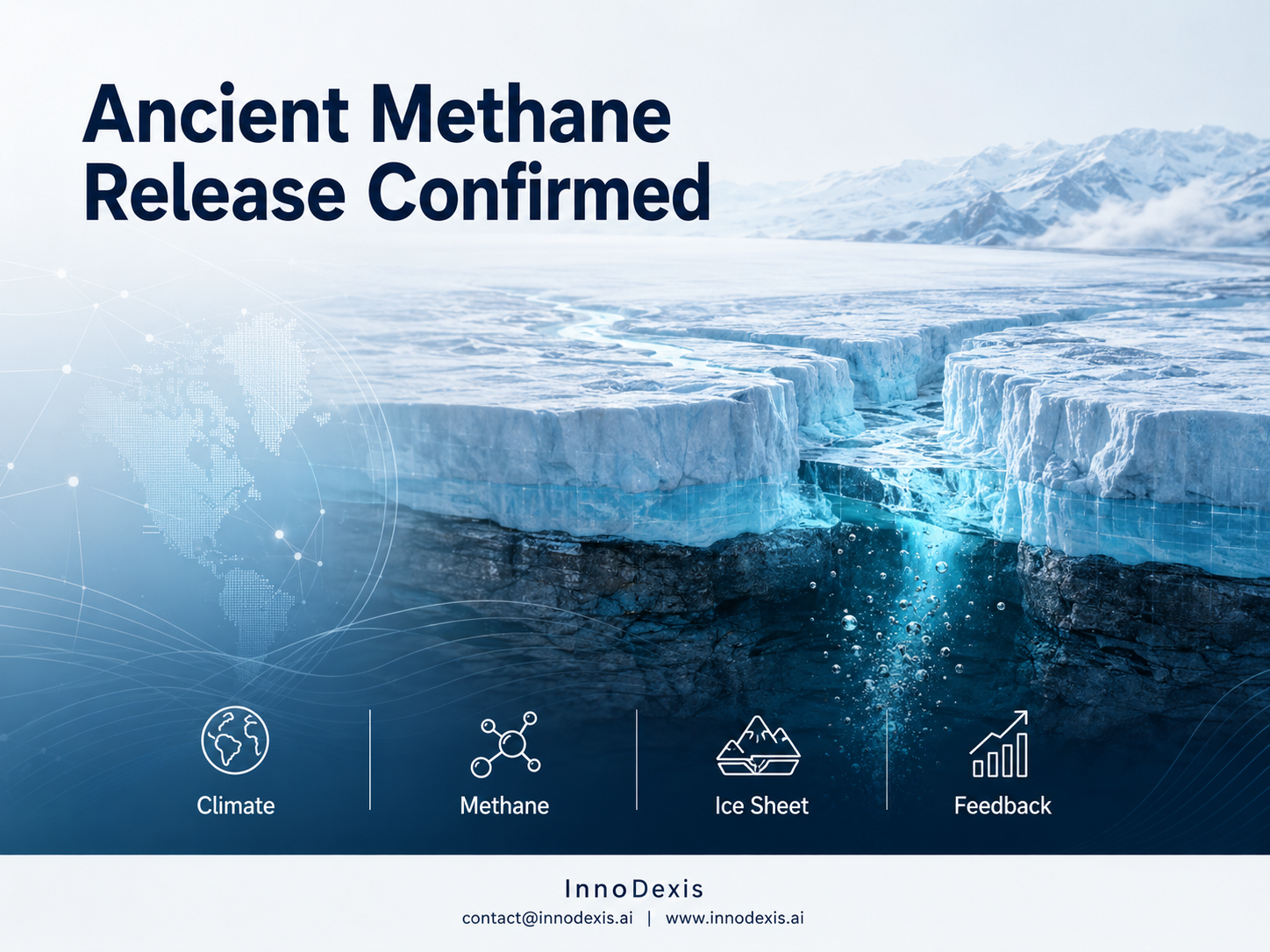
InnoDexis has published its latest Innovation Intelligence Report covering climate science and Earth systems research, analyzing recent methane findings beneath the Greenland Ice Sheet. The report reveals evidence that biologically produced methane dating back approximately 1,500 to 4,500 years is escaping from beneath the ice sheet as regional warming accelerates. Based on samples collected across a 2,000-kilometer Greenland transect, the findings suggest that ice sheets may function not only as indicators of climate change, but also as active contributors to greenhouse gas amplification.
Key Findings
Researchers from University of Oulu identified methane signatures beneath the Greenland Ice Sheet linked to warming periods during the Holocene Thermal Maximum. The findings indicate that biologically generated methane has remained preserved beneath glacial systems for millennia before being released under changing climatic conditions.
The study analyzed samples collected across a 2,000-kilometer transect spanning Greenland. This geographic scale strengthens the evidence that methane release may not represent an isolated regional anomaly, but rather a broader subglacial process associated with ice sheet dynamics.
Evidence from the research suggests that the Greenland Ice Sheet may be more climate-sensitive than previously assumed. The interaction between warming temperatures, glacial retreat, and methane mobilization indicates that ice-sheet responses could extend beyond physical melting alone.
The findings also suggest that retreating ice may accelerate greenhouse gas release from beneath the surface. As ice coverage decreases, previously trapped methane reservoirs may become increasingly exposed, introducing additional atmospheric emissions pathways.
The research positions subglacial methane as a potentially active climate feedback mechanism. Rather than functioning solely as passive indicators of warming, ice sheets may influence future warming trajectories through greenhouse gas release linked to environmental change.
Strategic Insight and Trend Analysis
The findings from University of Oulu indicate a structural shift in how ice sheets are understood within climate systems analysis. Traditionally, ice sheets have primarily been modeled as physical indicators of planetary warming through melting rates and sea-level contribution. The evidence of methane release introduces the possibility that glacial systems may also function as active greenhouse gas amplifiers.
This distinction is significant because feedback-driven warming mechanisms can alter the pace and complexity of climate projections. If retreating ice exposes ancient methane reservoirs at increasing scale, warming may reinforce itself through additional atmospheric methane emissions. Such interactions could influence temperature trajectories independently of contemporary industrial emissions patterns.
The connection to the Holocene Thermal Maximum further suggests that these mechanisms may have historical precedent during previous warming intervals. This provides a geological framework for understanding how subglacial carbon reservoirs respond under sustained temperature increases.
The broad sampling range across Greenland strengthens the implications for climate modeling. Rather than a localized phenomenon, the findings suggest the need to evaluate whether subglacial methane release should be incorporated more systematically into Earth system forecasting models. This may affect assumptions related to both warming acceleration and long-term sea-level projections.
Collectively, the research points toward a transition in climate science from viewing ice sheets as observational markers toward recognizing them as dynamic components within interconnected greenhouse gas systems.
Global and Industry Implications
For corporates and climate-focused R&D teams, the findings reinforce the importance of monitoring Earth system feedback mechanisms in long-term climate risk planning. Industries exposed to environmental transition risks may increasingly require models that incorporate secondary warming effects beyond direct emissions scenarios.
For investors and capital allocators, the emergence of methane-related feedback risks may influence assessments of climate resilience, infrastructure exposure, and sustainability-linked investments. Enhanced scrutiny of climate forecasting assumptions could affect long-duration capital allocation strategies.
For policymakers and national climate bodies, the evidence of subglacial methane release highlights the importance of integrating complex feedback mechanisms into climate policy and adaptation frameworks. Expanding research investment into polar monitoring and Earth system modeling may become increasingly significant for long-term planning.
InnoDexis Statement
“The Greenland findings indicate that ice sheets may operate not only as indicators of warming, but also as active contributors to greenhouse gas amplification through the release of long-preserved methane reservoirs,” noted InnoDexis in its latest intelligence report.
Conclusion
The detection of ancient methane escaping from beneath the Greenland Ice Sheet introduces new considerations for understanding climate system feedback dynamics. As warming accelerates and glacial retreat continues, the interaction between ice loss and greenhouse gas release may become increasingly relevant to future climate projections. Monitoring how these subglacial processes evolve will be critical in assessing long-term environmental and atmospheric risk trajectories. The complete Climate Systems and Subglacial Methane Intelligence Report is available to InnoDexis subscribers and enterprise clients.
About InnoDexis
InnoDexis is a global Innovation Intelligence platform that tracks, analyzes, and interprets breakthrough innovations, prototypes, and emerging technologies across industries and countries. Its intelligence helps corporates, investors, and policymakers understand the true structure and direction of global innovation. Learn more at innodexis.ai.