AI-Driven Radiotherapy Planning Targets Sub-15 Minute Workflows as UK Research Program Addresses Oncology Bottlenecks
A five-year initiative demonstrates how AI-enabled automation and real-time imaging could significantly reduce radiotherapy planning time and expand treatment capacity.
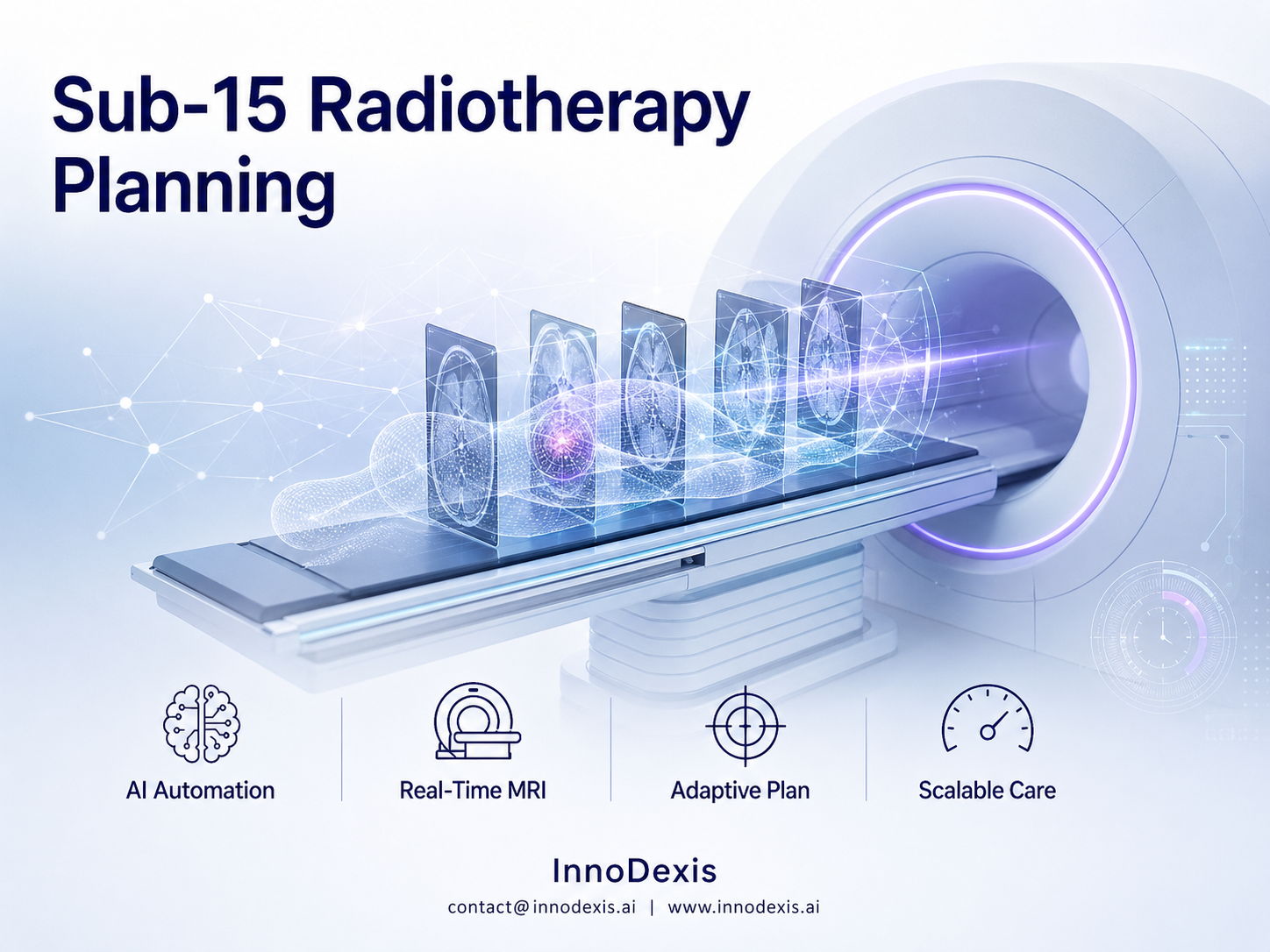
InnoDexis has published its latest Innovation Intelligence Report covering AI-driven radiotherapy innovation, analyzing a five-year research program led by The Institute of Cancer Research and The Royal Marsden NHS Foundation Trust. The report reveals that the program aims to reduce radiotherapy treatment planning time to under 15 minutes through the integration of artificial intelligence and real-time MRI analysis. By targeting one of the most resource-intensive stages in cancer care, the initiative highlights a structural shift toward scalable, time-efficient oncology systems.
Key Findings
A five-year research program is focused on compressing radiotherapy treatment planning timelines from several hours to under 15 minutes. This initiative directly addresses one of the primary operational constraints in cancer care, where planning complexity limits patient throughput and system efficiency.
Real-time MRI analysis is being used to predict anatomical changes during treatment. This capability enables adaptive planning based on patient-specific variations, supporting more precise targeting while reducing the need for repeated manual adjustments.
Automated segmentation combined with near-instant treatment planning workflows is central to the system design. By reducing manual intervention, the approach aims to standardize planning processes and minimize variability across clinical settings.
The program targets approximately a 50% reduction in overall workflow time. This level of efficiency gain suggests that planning capacity could expand without proportional increases in clinical staff or infrastructure.
The system is built on standard MRI platforms rather than specialized or experimental hardware. This design choice indicates a focus on broader deployment potential, enabling adoption beyond highly specialized or resource-rich cancer centers.
Strategic Insight and Trend Analysis
The findings indicate a transition in radiotherapy from a precision-limited model to a scalability-oriented system. Historically, treatment planning has required extensive clinician time and expertise, creating a bottleneck that constrains the number of patients who can receive timely care. By reducing planning time to under 15 minutes, the research program shifts the limiting factor away from workflow duration toward system capacity and implementation.
The integration of real-time imaging and AI-driven automation reflects a broader trend in oncology toward adaptive treatment systems. Rather than relying on static plans, emerging approaches are designed to respond dynamically to patient-specific changes during therapy. This evolution aligns with the increasing emphasis on precision while addressing operational inefficiencies.
The use of standard MRI infrastructure suggests that the innovation is not confined to specialized environments. Instead, it signals an attempt to redesign radiotherapy workflows at a systems level, making advanced planning capabilities more accessible across healthcare networks. This approach indicates that the next phase of oncology innovation may focus on deployment scalability as much as technical performance.
Collectively, these developments point toward a redefinition of radiotherapy as an infrastructure-driven capability. The ability to automate and accelerate planning processes positions radiotherapy not only as a clinical intervention but as a scalable component of national and global cancer treatment systems.
Global and Industry Implications
For corporates and R&D teams, the findings suggest increasing importance of integrating AI, imaging, and workflow automation into radiotherapy solutions. Companies developing oncology technologies may need to prioritize interoperability with existing imaging systems and focus on reducing operational complexity.
For investors and capital allocators, the shift toward workflow optimization and infrastructure scalability highlights opportunities in platforms that enhance treatment throughput. Solutions that address system-level constraints rather than single-point innovations may offer broader adoption potential.
For policymakers and national innovation bodies, the potential to reduce planning time and expand treatment capacity has implications for healthcare system efficiency. Supporting adoption of AI-enabled radiotherapy workflows could help address disparities in access and reduce pressure on oncology services.
InnoDexis Statement
The reduction of radiotherapy planning time to minutes reflects a structural shift from expertise-constrained workflows to scalable, AI-enabled treatment systems, with implications for how cancer care capacity is expanded globally,” noted InnoDexis in its latest intelligence report.
Conclusion
The research program led by The Institute of Cancer Research and The Royal Marsden NHS Foundation Trust highlights a critical transition in oncology infrastructure. By targeting the time-intensive planning phase, AI-driven radiotherapy systems may enable broader access to precision treatment while improving system efficiency. As planning approaches near real-time execution, future constraints may shift toward infrastructure availability, data integration, and clinical adoption. The complete Radiotherapy Innovation Intelligence Report is available to InnoDexis subscribers and enterprise clients.
About InnoDexis
InnoDexis is a global Innovation Intelligence platform that tracks, analyzes, and interprets breakthrough innovations, prototypes, and emerging technologies across industries and countries. Its intelligence helps corporates, investors, and policymakers understand the true structure and direction of global innovation. Learn more at innodexis.ai.