AI-Designed Synthetic Proteins Enable Simultaneous Tracking of 30 Cellular Targets as De Novo Protein Design Reshapes Biological Imaging
Researchers from EMBL Heidelberg, Janelia Research Campus, and the Institute for Protein Design have developed NovoTags AI-designed synthetic proteins that distinguish up to 30 cellular targets simultaneously using combined spectral and fluorescence lifetime information in living cells.
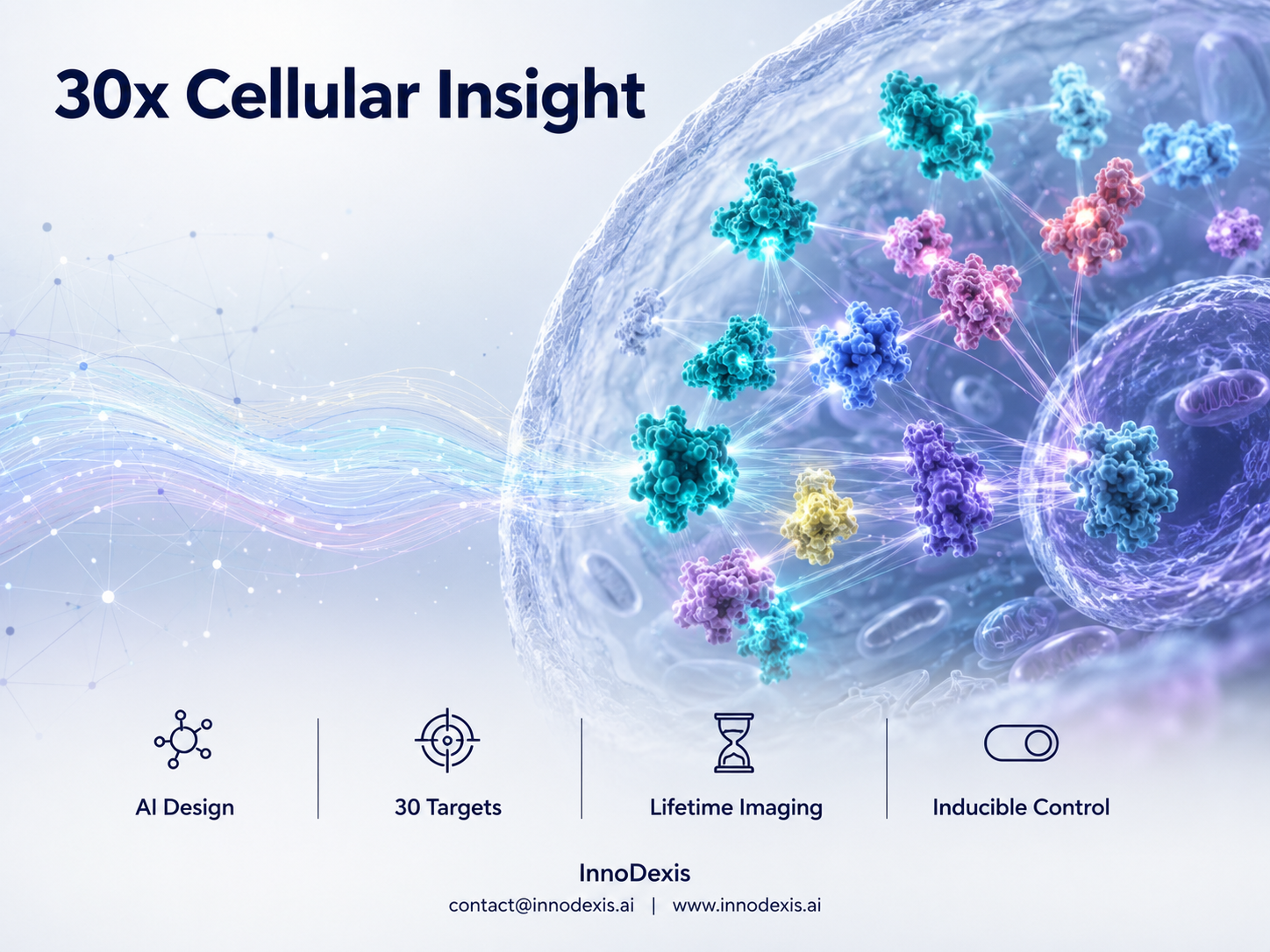
InnoDexis has published its latest Innovation Intelligence Report covering AI-driven protein design and cellular imaging technology, analyzing a high-significance innovation developed across institutions in Germany and the United States. The report reveals that researchers at EMBL Heidelberg, Janelia Research Campus, and the Institute for Protein Design have created NovoTags — synthetic proteins designed entirely from scratch using AI tools — capable of simultaneously distinguishing up to 30 different proteins inside living human cells, while a companion innovation, NovoSplit, enables inducible control of protein-protein interactions using a fluorescent dye as a molecular trigger.
Key Findings
NovoTags distinguish up to 30 different proteins simultaneously by combining emission spectrum and fluorescence lifetime information — a capability that substantially exceeds what existing fluorescent tagging systems allow. This multiparameter approach resolves a fundamental limitation of conventional fluorescent tags, which rely on spectral information alone and are constrained in the number of targets they can distinguish within a single imaging session.
The NovoTag system was designed entirely from scratch using three AI tools — RFdiffusion, LigandMPNN, and AlphaFold — without derivation from natural enzymes. This represents a shift in biological tool design from adapting what nature evolved to constructing functional proteins from computational principles alone. The resulting synthetic proteins bind fluorescent dyes for multicolour, super-resolution imaging inside living cells, validated in human cell lines using live STED microscopy and fluorescence lifetime imaging.
NovoSplit, a key companion innovation within the NovoTag system, uses a fluorescent dye as molecular glue to switch protein-protein interactions on and off on demand. This inducible control capability moves beyond passive observation of cellular processes — enabling researchers to actively manipulate protein interactions at a defined moment, adding a temporal dimension to cellular imaging that existing tools do not provide.
The NovoTag sequences and complementary dyes have been made freely available to the scientific community. This open-access distribution model positions NovoTags as a shared infrastructure resource for cell biology and disease research, rather than a proprietary tool — broadening the potential scope of downstream application across research institutions globally.
The innovation is backed by a $500 million Howard Hughes Medical Institute commitment, signalling institutional confidence in the long-term potential of AI-native biological tool design as a field. This funding context situates NovoTags within a broader programmatic investment in de novo protein design rather than as an isolated research output.
Strategic Insight and Trend Analysis
The most significant strategic signal in this dataset is not the specific performance of NovoTags — though distinguishing 30 proteins simultaneously is a meaningful technical advance — but what the design methodology represents for the future of biological tool development. The entire NovoTag system was constructed using AI tools without reference to natural protein templates. This establishes a proof of concept that computational design can produce functional biological tools that outperform those derived from natural evolution.
This matters structurally because biological research has historically been constrained by the toolkit that nature provides. Fluorescent proteins, restriction enzymes, CRISPR systems — all emerged from natural biological systems that researchers then adapted. The NovoTag methodology inverts this dependency: instead of searching nature for a protein with useful properties and engineering it further, the design process begins with the desired function and builds a protein to match it computationally.
The addition of NovoSplit's inducible interaction control extends this logic further. The ability to use a small-molecule dye as a molecular switch — turning protein interactions on and off at a defined moment — introduces a level of experimental control over cellular processes that passive imaging tools cannot provide. For disease research, where understanding the timing and sequence of protein interactions is as important as identifying which proteins interact, this temporal control capability has direct implications for how cellular dysfunction is studied.
The open-access release of NovoTag sequences and dyes accelerates the compounding value of this innovation. Platform-level biological tools that are freely distributed tend to generate disproportionate downstream scientific return, as the research community applies them across problem domains the original developers did not anticipate.
Global and Industry Implications
For corporates and R&D teams in pharmaceutical and biotechnology research, NovoTags offer a materially improved imaging infrastructure for studying protein behaviour in living cells. The ability to track 30 targets simultaneously with interaction control has direct application in drug discovery programmes focused on protein-protein interactions, cellular signalling pathways, and disease mechanism research — areas where understanding the dynamic behaviour of multiple proteins simultaneously is a persistent technical challenge.
For investors and capital allocators, the $500 million HHMI commitment signals institutional conviction in AI-native protein design as a durable research direction rather than a single-study finding. The convergence of de novo protein design, super-resolution microscopy, and fluorescence lifetime imaging in a single validated platform points to a broader tooling infrastructure buildout in cell biology that warrants monitoring across both academic and commercial development pipelines.
For policymakers and national innovation bodies, the multi-institutional collaboration spanning EMBL Heidelberg, Janelia Research Campus, and the Institute for Protein Design demonstrates the structural value of cross-border research infrastructure in producing platform-level biological innovations. Supporting international collaboration frameworks in AI-driven life sciences research is likely to accelerate the pace at which foundational tools of this type are developed and made publicly available.
InnoDexis Statement
"NovoTags signal a structural shift in biological tool design — from adapting natural proteins to constructing functional systems from computational first principles — with direct implications for how cellular disease processes are studied and eventually targeted therapeutically," noted InnoDexis in its latest intelligence report.
Conclusion
As AI-driven protein design matures from theoretical capability to validated experimental tool, the ceiling of what biological imaging and interaction control can achieve is being actively redefined. NovoTags represent an early, concrete demonstration of what de novo protein design can produce when applied to a well-defined research need. InnoDexis will continue to monitor developments in AI-native biological tool design, super-resolution imaging infrastructure, and the downstream application of synthetic protein platforms in disease research and drug discovery. The complete AI Protein Design Innovation Intelligence Report is available to InnoDexis subscribers and enterprise clients.
About InnoDexis
InnoDexis is a global Innovation Intelligence platform that tracks, analyzes, and interprets breakthrough innovations, prototypes, and emerging technologies across industries and countries. Its intelligence helps corporates, investors, and policymakers understand the true structure and direction of global innovation. Learn more at innodexis.ai.