AI-Designed Catalyst Demonstrates Higher Activity Than Commercial Platinum Catalysts in Hydrogen Fuel Cells - KAIST and Seoul National University Research Signals Shift in Materials Discovery
Machine learning combined with quantum chemistry simulations produced a zinc–platinum–cobalt catalyst with improved activity and durability, highlighting AI’s expanding role in advanced materials design.
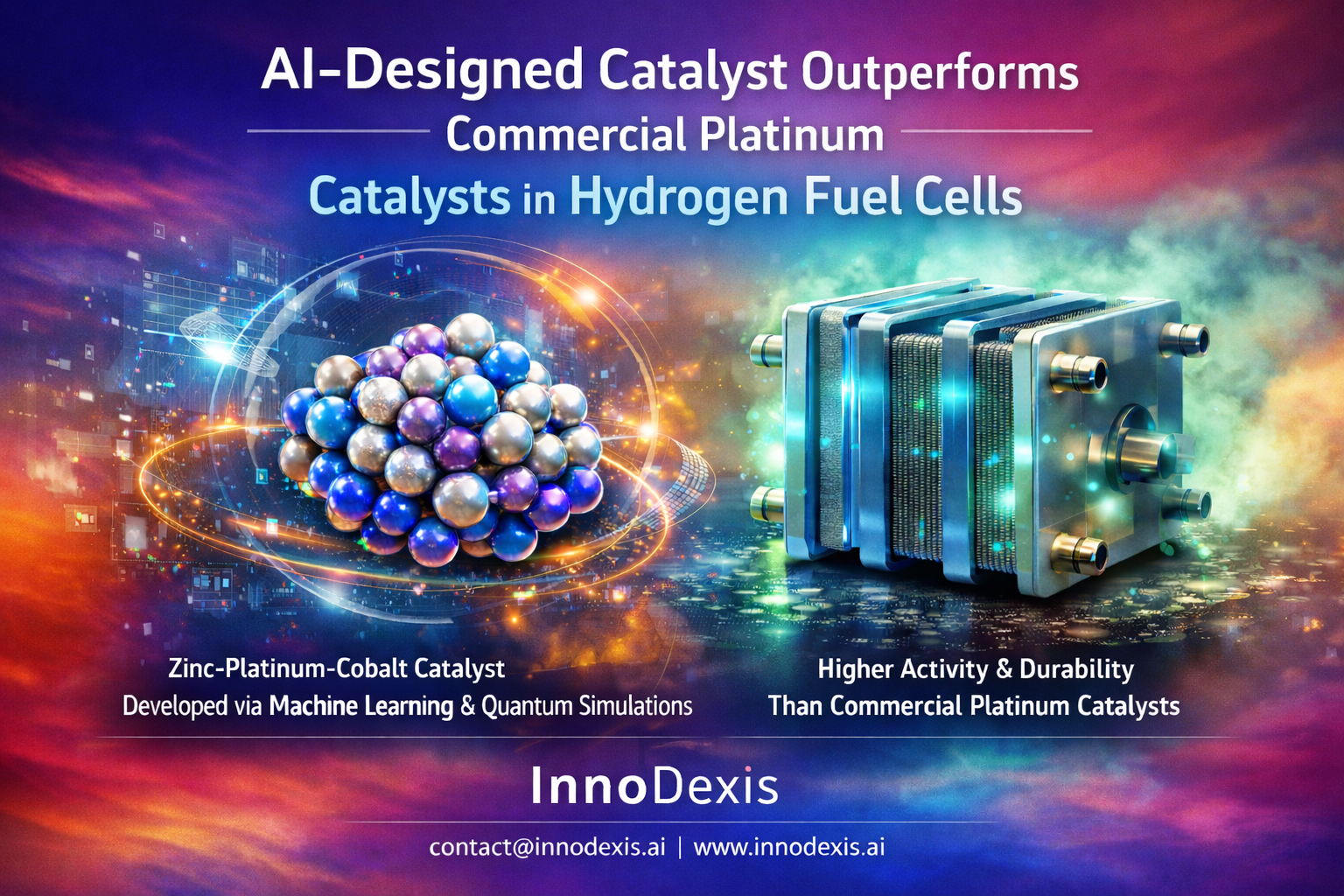
InnoDexis has published its latest Innovation Intelligence Report covering artificial intelligence–driven materials discovery, analyzing emerging research in hydrogen fuel cell catalyst development. The report reveals that researchers from KAIST and Seoul National University used machine learning models integrated with quantum chemistry simulations to design a zinc–platinum–cobalt catalyst prior to laboratory synthesis. When experimentally produced, the catalyst demonstrated higher activity than commercial platinum catalysts along with improved long-term durability. The study highlights a growing methodological shift in materials science where computational design increasingly precedes experimental validation.
Key Findings
Researchers from KAIST and Seoul National University applied machine learning models combined with quantum chemistry simulations to design a new hydrogen fuel cell catalyst composed of zinc, platinum, and cobalt. The computational framework enabled the prediction of atomic configurations before the catalyst was synthesized experimentally in the laboratory.
Experimental validation showed that the newly designed catalyst exhibited higher catalytic activity than commercially used platinum catalysts. Catalytic activity directly influences the efficiency of hydrogen fuel cells by determining how effectively electrochemical reactions occur at the electrode surface.
The catalyst also demonstrated improved long-term durability compared with conventional platinum-based catalysts. Durability is a critical factor in fuel cell deployment because catalyst degradation directly affects operational lifespan and maintenance requirements.
The research highlights the integration of artificial intelligence into materials science workflows. Machine learning models are increasingly capable of predicting atomic structures and material configurations that historically required extended laboratory experimentation to identify.
Catalyst performance remains a central factor in hydrogen fuel cell commercialization. Improvements in catalytic efficiency and durability can reduce system costs and enhance operational stability, both of which influence the broader adoption of hydrogen fuel cell technologies.
Strategic Insight and Trend Analysis
The catalyst discovery process demonstrated in this research reflects a broader transition in advanced materials science toward computationally guided design frameworks. Traditionally, catalyst discovery relied on iterative laboratory experimentation in which researchers tested large numbers of material combinations over extended timeframes. The integration of machine learning and quantum chemistry simulations introduces a predictive approach capable of narrowing candidate materials before synthesis occurs.
AI-guided modeling enables researchers to evaluate atomic configurations and chemical interactions computationally, allowing potential catalysts to be screened digitally before physical experiments begin. This shift can reduce the number of experimental cycles required to identify promising materials and potentially shorten development timelines.
In the context of hydrogen fuel cells, catalyst performance directly influences energy efficiency, durability, and overall system cost. Platinum remains a widely used catalyst due to its catalytic performance, but improving catalyst activity and durability can influence the economic viability of fuel cell systems. The zinc–platinum–cobalt catalyst identified in this research demonstrates how AI-assisted discovery methods may contribute to performance improvements in this domain.
The broader implication lies in the methodological shift rather than a single catalyst discovery. AI-driven materials design frameworks are increasingly being applied across multiple domains including energy storage, catalysis, and semiconductor materials. As computational capabilities expand and datasets improve, the integration of machine learning with quantum chemistry modeling may become a standard component of materials discovery pipelines.
Global and Industry Implications
For corporates and R&D teams working in hydrogen technologies and advanced materials, AI-assisted discovery methods provide a potential pathway to accelerate catalyst development cycles. The ability to computationally predict material configurations may support faster iteration and more targeted experimental validation.
For investors and capital allocators, the convergence of artificial intelligence and materials science represents a growing area of deep-technology development. Companies and research groups applying computational discovery techniques may influence future innovation pipelines in energy, chemicals, and industrial materials.
For policymakers and national innovation bodies, advances in AI-driven materials research highlight the importance of interdisciplinary capabilities that combine computational science, chemistry, and engineering. Support for such integrated research environments may influence national competitiveness in emerging energy technologies.
InnoDexis Statement
“The integration of machine learning and quantum chemistry in catalyst design illustrates how computational methods are beginning to reshape materials discovery processes, potentially altering the timelines through which advanced energy technologies reach practical deployment,” noted InnoDexis in its latest intelligence report.
Conclusion
The development of a zinc–platinum–cobalt catalyst designed through machine learning and quantum chemistry modeling demonstrates the increasing role of artificial intelligence in materials science research. Beyond the catalyst itself, the study highlights a methodological shift toward computationally guided discovery, where predictive modeling informs experimental validation. As hydrogen technologies continue to evolve, such approaches may influence how quickly new materials move from theoretical design to laboratory confirmation and eventual industrial application. The complete AI-Driven Materials Innovation Intelligence Report is available to InnoDexis subscribers and enterprise clients.
About InnoDexis
InnoDexis is a global Innovation Intelligence platform that tracks, analyzes, and interprets breakthrough innovations, prototypes, and emerging technologies across industries and countries. Its intelligence helps corporates, investors, and policymakers understand the true structure and direction of global innovation. Learn more at innodexis.ai.