Advanced Materials Fabrication Emerges as a Constraint Shift in Quantum Computing Development
A new fabrication method from the California Institute of Technology indicates that material processing, rather than theory, may define the next phase of quantum hardware progress.
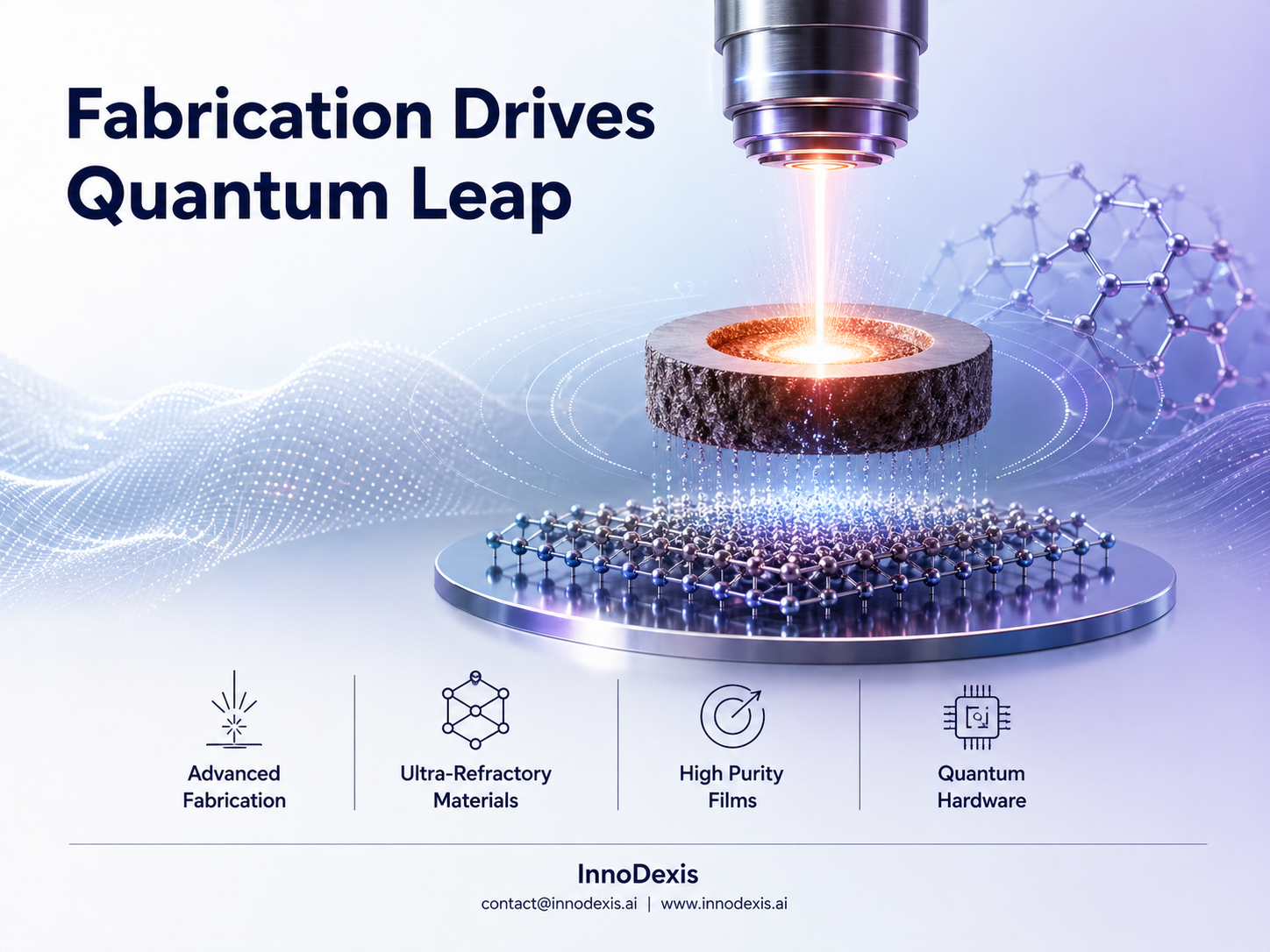
InnoDexis has published its latest Innovation Intelligence Report covering quantum materials and advanced manufacturing, analyzing emerging fabrication innovations in quantum-relevant materials. The report reveals that a newly introduced method, Thermal Laser Evaporation, addresses long-standing constraints in extreme heat handling during material synthesis. By eliminating the need for a traditional crucible and enabling localized heating, the approach demonstrates potential to improve material purity and compatibility, particularly for ultra-refractory materials used in quantum systems.
Key Findings
Researchers at California Institute of Technology have introduced Thermal Laser Evaporation, a fabrication method designed to overcome heat-related limitations in advanced materials processing. The approach represents a shift in how high-temperature materials can be handled during thin-film deposition.
The method uses laser-localized heating to melt only the core of a material pellet while leaving surrounding structures unaffected. This selective heating mechanism reduces thermal stress on containment systems and enables controlled processing of materials at extreme temperatures.
A self-crucible effect is achieved during the process, where the material effectively contains itself. By removing the need for an external crucible, the method reduces risks of contamination and structural failure, which are common challenges in high-temperature fabrication environments.
Thermal Laser Evaporation demonstrates compatibility with ultra-refractory materials exceeding 3000 K, including elements such as niobium. This expands the range of materials that can be processed for applications requiring high thermal and structural stability.
The resulting thin films produced through this method match or exceed the performance of conventional deposition techniques. This indicates that the process does not compromise material quality while introducing new fabrication flexibility.
Strategic Insight and Trend Analysis
The findings indicate a structural shift in quantum technology development, where fabrication capabilities are emerging as a defining constraint. While theoretical frameworks and algorithmic advances in quantum computing have progressed significantly, the ability to manufacture ultra-pure, precisely engineered materials remains a limiting factor.
Thermal Laser Evaporation addresses this constraint by redefining how extreme-temperature materials are processed. The removal of the traditional crucible and the introduction of localized heating represent a transition from containment-limited fabrication to material-driven processing. This enables new classes of materials to be explored without being restricted by conventional manufacturing boundaries.
Quantum systems, particularly those relying on superconducting components, require materials with high purity and structural precision. The demonstrated compatibility with ultra-refractory materials suggests that fabrication techniques may now begin to align more closely with the material requirements of advanced quantum architectures.
This shift reflects a broader trend in deep technology sectors, where innovation is increasingly driven by enabling infrastructure rather than end applications alone. The transition from material limitations constraining fabrication to fabrication unlocking material possibilities suggests that manufacturing methodologies may become a central driver of future breakthroughs in quantum computing.
Global and Industry Implications
For corporates and R&D teams, the emergence of advanced fabrication methods highlights the importance of integrating materials science capabilities into quantum development strategies. Access to improved material processing techniques may influence hardware performance and scalability.
For investors and capital allocators, the findings indicate that value creation in quantum computing may extend beyond software and algorithms to include materials engineering and manufacturing technologies. Opportunities may emerge in companies focused on enabling the physical infrastructure of quantum systems.
For policymakers and national innovation bodies, advancements in fabrication techniques underscore the strategic importance of supporting materials research and semiconductor manufacturing capabilities. Strengthening these areas may contribute to long-term competitiveness in quantum technology development.
InnoDexis Statement
The introduction of fabrication methods such as Thermal Laser Evaporation suggests that the next phase of quantum advancement will depend on how effectively material constraints are addressed through manufacturing innovation,” noted InnoDexis in its latest intelligence report.
Conclusion
The development of Thermal Laser Evaporation reflects a broader transition in quantum computing, where progress may increasingly depend on advances in materials fabrication rather than theoretical breakthroughs alone. As demand grows for ultra-pure, high-performance materials, manufacturing techniques that enable scalability and precision will play a central role. Monitoring how such methods are adopted and integrated into quantum hardware development will be critical in assessing future progress. The complete Quantum Materials Innovation Intelligence Report is available to InnoDexis subscribers and enterprise clients.
About InnoDexis
InnoDexis is a global Innovation Intelligence platform that tracks, analyzes, and interprets breakthrough innovations, prototypes, and emerging technologies across industries and countries. Its intelligence helps corporates, investors, and policymakers understand the true structure and direction of global innovation. Learn more at innodexis.ai.