72% of Innovations Remain Pre-Commercial as Only 65 Near-Market Opportunities Emerge from 4,390 Tracked Cases
A global analysis reveals a structural gap between early-stage discovery and commercialization, with the tightest bottleneck concentrated in mid-stage development.
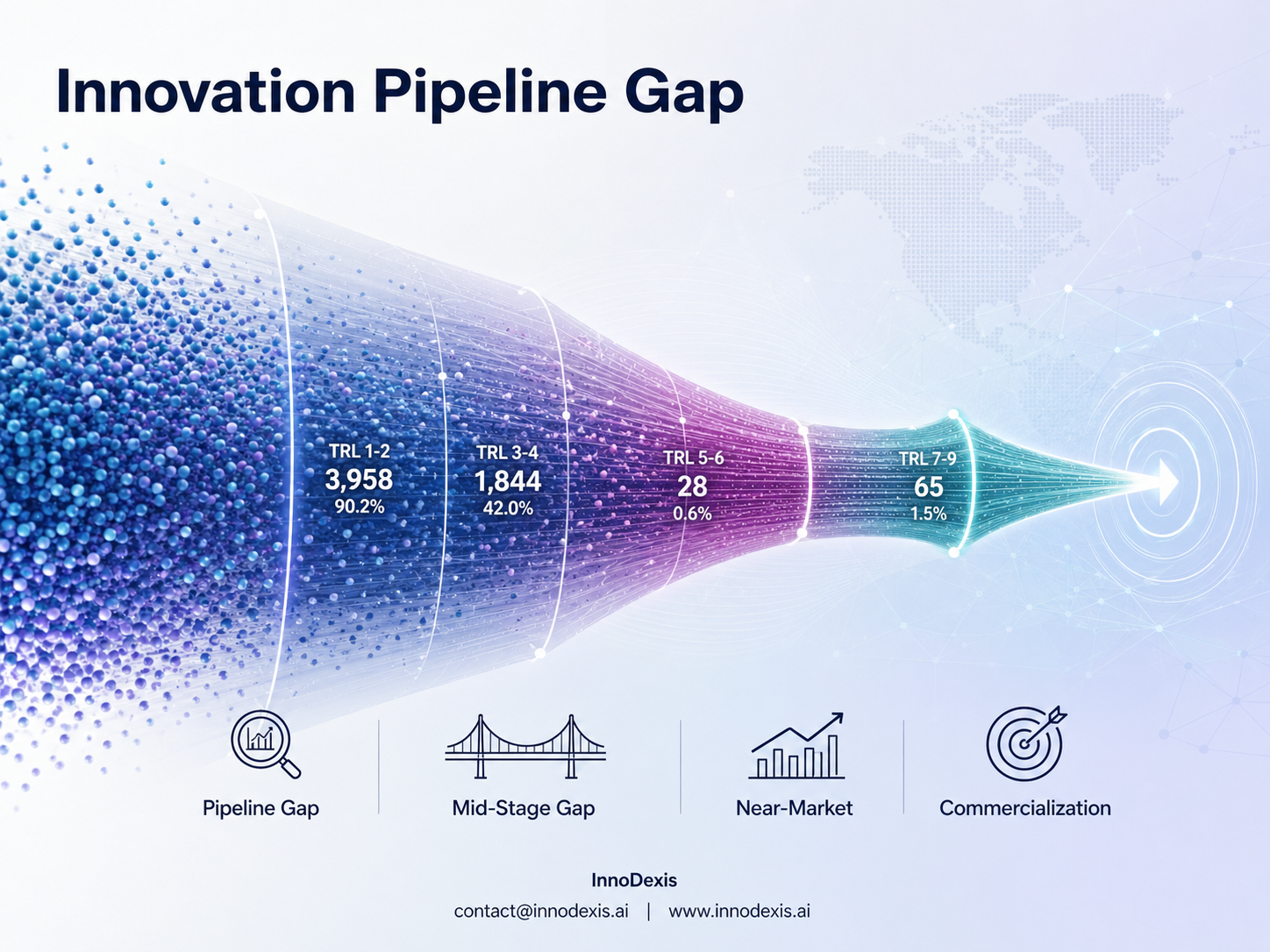
InnoDexis has published its latest Innovation Intelligence Report covering technology readiness levels (TRL), analyzing 4,390 innovations across multiple domains during March 2026. The report reveals that while innovation activity remains strong at early stages, only 332 innovations demonstrate clear TRL signals, and just 65 are positioned near market readiness. The findings indicate a structural gap between discovery and commercialization, with limited transition support across mid-stage development constraining the movement of innovations toward deployment.
Key Findings
A total of 4,390 innovations were tracked in March 2026, providing a broad view of global innovation activity across sectors. However, only 332 innovations were associated with clearly defined technology readiness level (TRL) indicators, suggesting limited visibility into maturity progression across the majority of the pipeline.
Early-stage development dominates the innovation landscape, with 42% of tracked innovations clustered within TRL 3–4. This concentration indicates that discovery and proof-of-concept activity are advancing rapidly, outpacing the mechanisms required to support downstream commercialization.
Only 65 innovations fall within TRL 7–9, representing technologies that are near market readiness. This limited number highlights a narrow segment of the pipeline where execution, scaling, and deployment opportunities are most immediate.
The mid-stage segment, often described as the “Valley of Death,” contains just 28 innovations within TRL 5–6. This represents the most constrained transition point in the system, where technologies must move from validation to scalable application.
Approximately 50% of mid-stage innovations demonstrate high disruption potential, indicating that a significant portion of high-impact technologies are concentrated within the most resource-constrained phase of development.
Strategic Insight and Trend Analysis
The March 2026 TRL dataset highlights a structural imbalance between early-stage innovation output and mid-to-late-stage commercialization pathways. While discovery activity is substantial, as evidenced by the concentration of innovations in TRL 3–4, progression through the pipeline is not proportionally supported.
The limited number of innovations in TRL 5–6 suggests that the transition from validation to scale represents a critical bottleneck. This stage requires coordinated access to capital, industry partnerships, and infrastructure—elements that appear misaligned with where innovation risk and opportunity are most concentrated.
At the same time, the presence of only 65 near-market innovations indicates that successful progression through this bottleneck is relatively rare. As a result, the pipeline narrows significantly before reaching deployment stages, limiting the translation of early-stage breakthroughs into commercial outcomes.
The finding that approximately half of mid-stage innovations carry high disruption potential further emphasizes the strategic importance of this segment. These innovations combine technical validation with transformative potential, yet remain constrained by limited support structures.
Collectively, the data suggests a shift in how innovation systems may need to be structured. Rather than prioritizing early-stage ideation alone, there is increasing evidence that value creation depends on enabling transitions across development stages. The “Valley of Death” emerges not only as a risk zone but as a focal point where intervention could significantly influence commercialization outcomes.
Global and Industry Implications
For corporates and R&D teams, the findings highlight the importance of engaging with mid-stage innovations where validation has been established but scaling pathways remain underdeveloped. Strategic partnerships at this stage may provide access to high-potential technologies before broader market entry.
For investors and capital allocators, the concentration of high disruption potential within TRL 5–6 suggests a segment characterized by elevated risk alongside significant upside. The limited number of near-market innovations indicates that competition for late-stage opportunities may remain concentrated, while mid-stage investments may offer differentiated positioning.
For policymakers and national innovation bodies, the data underscores the need to strengthen support mechanisms that enable progression from validation to commercialization. Addressing gaps in funding, infrastructure, and collaboration at mid-stage levels may be critical to improving overall innovation system efficiency.
InnoDexis Statement
“The March 2026 TRL analysis indicates that innovation systems are not constrained by idea generation, but by the ability to support transitions between development stages where both risk and potential are highest,” noted InnoDexis in its latest intelligence report.
Conclusion
The March 2026 InnoDexis TRL Intelligence Report presents a global innovation landscape characterized by strong early-stage activity and limited progression toward commercialization. With only a small fraction of innovations reaching near-market readiness and a constrained mid-stage pipeline, the ability to bridge development gaps will likely define future innovation outcomes. Monitoring how capital, partnerships, and policy frameworks evolve to support these transitions will be essential. The complete March 2026 InnoDexis TRL Intelligence Report is available to InnoDexis subscribers and enterprise clients.
About InnoDexis
InnoDexis is a global Innovation Intelligence platform that tracks, analyzes, and interprets breakthrough innovations, prototypes, and emerging technologies across industries and countries. Its intelligence helps corporates, investors, and policymakers understand the true structure and direction of global innovation. Learn more at innodexis.ai.